

Rethink your governance by engaging your stakeholders more broadly!
COLLABORATIVE LEADERSHIP TRAINING
A five-day journey to transform your approach by discovering the power of collective intelligence, shared governance, and practical tools for navigating complexity.
Ready to advance collaboration toward ‘new horizons’ by developing your collaborative leadership skills?
What is collaborative leadership?
Collaborative leadership is based on principles of equity and interaction, fostering a participatory working dynamic to solve challenges, achieve goals, and stimulate both individual and collective growth.
This approach helps strengthen team engagement, encourage innovation, and build interpersonal relationships, thereby contributing to a positive and lasting dynamic within an organization or community.
In which contexts is it relevant?
En tant qu’entrepreneur.e, pour repenser sa gouvernance et adopter un modèle collaboratif qui fonctionne vraiment et soutien à la fois les individus et la planète.
As a team leader, to guide your team through complexity, manage tight deadlines and changing demands, while creating an environment where each member feels valued and fully invested in the project’s success.
As a consultant, to rethink your way of working by prioritizing co-creation and making your clients active participants in their own transformation.
Our LC training
With this training, you’ll learn:
1. A methodology for solving complex and volatile problems: the 4D innovation methodology (Design Thinking & Lean Startup)
2. Facilitation: Because collaborative governance requires skills in managing collective processes!
Learning Objectives
By the end of the training, you will be able to guide teams to:
- Explore an issue to uncover its root causes
- Co-create creative and sustainable solutions
- Make decisions
- Promote dialogue among stakeholders
And, quite simply, enable a group to establish a solid foundation for collaboration to successfully carry out a project.
For whom?
For those who lead change and explore new ways of collaborating to realize their ambitions.
Consultants
Respond more effectively and collaboratively to your clients’ needs.
Managers
Support your teams! Strengthen your leadership skills.
Entrepreneurs
creatives
Learn to engage others and co-create!
12-13,19-20 & 27th of MARCH 2026
Next session
12-13,19-20 & 27th of MARCH 2026
next session
12-13,19-20 & 27th of MARCH 2026
Next session
12-13,19-20 & 27th of MARCH 2026
next session
where?
We meet each training day at our offices — Avenue Louise 251, 1050 Brussels.
when?
Next session will be on the 12-13, 19-20 & 27th of March 2026.
with whom?
La prochaine session sera en Français avec Alexandre Philippe.
how much?
All-inclusive, the training costs €1,800 excluding VAT. Freelancers and entrepreneurs have access to regional support to participate (see INSIGHTS).
What does it include?
The price includes educational materials, meals and beverages, as well as an environment conducive to optimal knowledge transfer.
questions?
For any questions, clarifications, or requests for further explanations, we will respond at the following address: oceane@impact-valley.com.
Note: The training will only take place if a minimum of five participants is reached.
12-13,19-20 & 27TH OF MARCH 2026
Next session
12-13,19-20 & 27TH OF MARCH 2026
Next session
12-13,19-20 & 27TH OF MARCH 2026
Next session
12-13,19-20 & 27TH OF MARCH 2026
Next session
Our Pedagogy
We have designed our training to make you an active participant in your learning. You learn by experiencing things firsthand:
AWARENESS
We start with an exercise to spark the desire to learn.
THEORY
We give you a concrete tool to help you build your skills.
PRATICE
We offer you the opportunity to practice the theory with concrete cases drawn from our field experiences.
Feedback
The trainer and the group provide you with feedback on your practice in a safe environment.
why us?
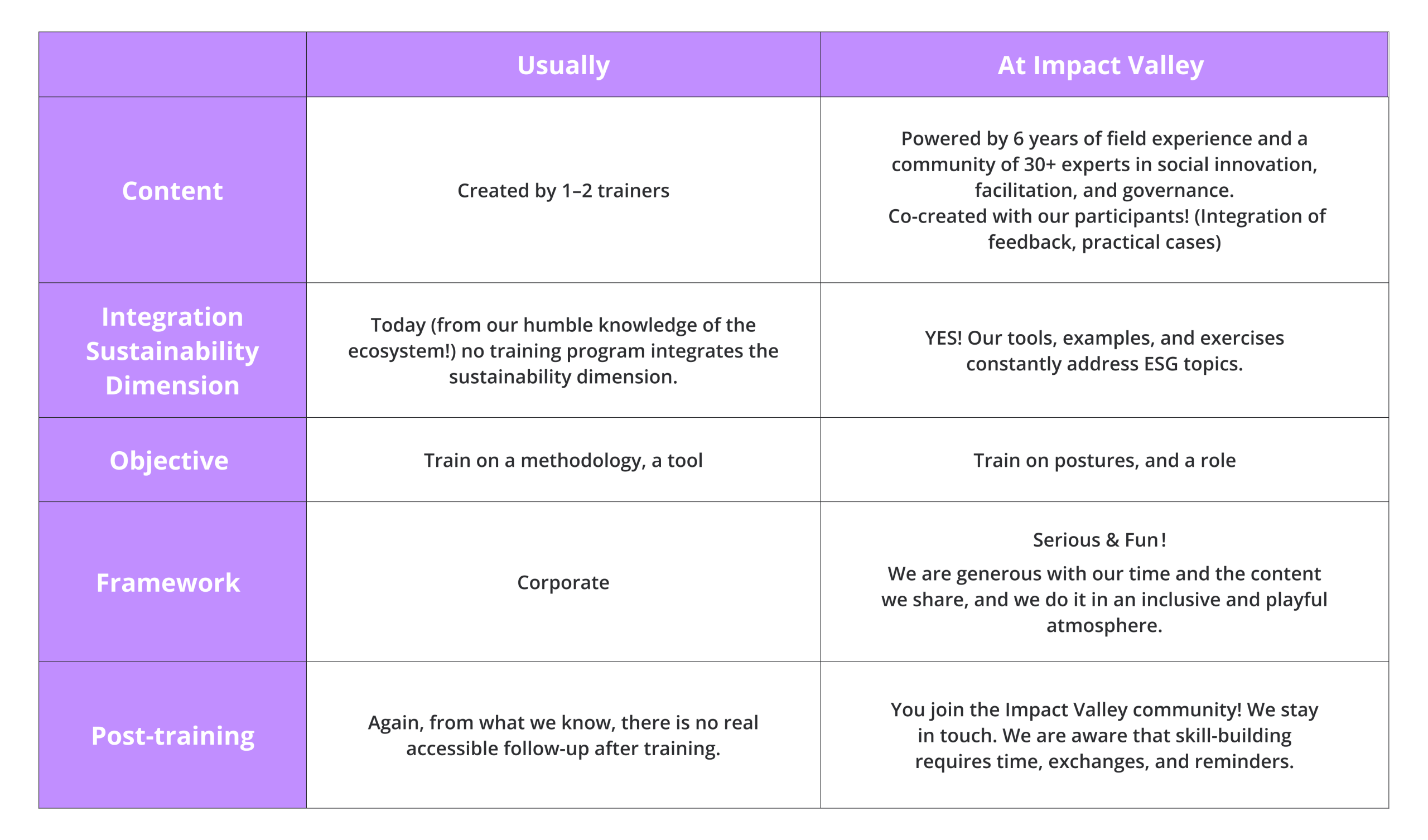
Discover why our training is unique and how we stand out from the rest.
IN DETAILS
Get to know the different stages and modules of our LC training to better understand what you will learn during the course sessions.
day 1
The posture
Understand your role:
- Know your ole
- Keep the big picture
- Cultivate positive thinking
- Sense and adapt to the different subgroups
- Active listening
Build a collaborative framework:
- Which collaboration rules to choose?
- Kick off the collective dynamic with an ice-breaker / check-in tool
- Close the session and allow participants to reflect on what just happened: check-out
Learn how to give a feedback:
- REA & DESC methods
day 2
Step 1 & 2 of the 4D methodology : Discover + Design
Set the framework / define the starting problem:
- Practice active listening — ask the right questions to stakeholders
- Build a structured problem statement
- Tool: How might we + action verb + persona + desired transformation
Step 1 — Discover :
- Reframe the problem: Identify the root causes of the issue
- Example tools: 5 Whys, Fishbone Diagram
- Understand the context: Who are the stakeholders? What are the market trends? What are competitors doing? etc.
- Example tools: Context Map, Stakeholder Map
- Identify opportunities / Build empathy
- Example tools: Empathy Map, Customer Journey, Persona”
Step 2 — Design :
- Stimulate creativity, think outside the box, break mental patterns (techniques and exercises to help participants enter a mindset where mistakes are allowed, bad ideas don’t exist, judgment is absent, and imagination is encouraged)
- Diverge and converge: Generate as many solutions as possible and sort each idea according to success criteria
- Example tools: GPS Brainstorming / Now How Wow Matrix”
day 3
Step 3 of the 4D methodology: Define
Move from an idea to a value proposition (project):
- Make a decision, align the group
- Define the key elements of your proposition
- Example tools: Voting, Consensus / Consent, Value Proposition Canvas
Move from an idea to a project — lay the foundations for defining a project:
- The mission model canvas
day 4 & 5
Step 4 of the 4D methodology: Develop + Pratice
- Lay the foundations for creating a prototype/action plan/pitch
- Practical synthesis exercise
It is important to create a common thread between all tools and different phases. We conclude our training with a synthesis exercise where participants map out an innovation journey using key tools to address a fictional problem.
12-13,19-20 & 27th of march 2026
next session
12-13,19-20 & 27th of march 2026
next session
12-13,19-20 & 27th of march 2026
next session
12-13,19-20 & 27th of march 2026
next session
What they appreciated
Whether it’s a first introduction to innovation facilitation or refining your approach and toolkit, the LC training supports your skill development at every stage of your journey toward greater collaboration and sustainability.
Show the example
I spent four days in an intense and intellectually joyful training.
The program was very well thought out and allowed for highly practical learning paths.
I appreciated the numerous examples and exercises built on a theoretical foundation that provided solid understanding.
The trainer was excellent, attentive and responsive to requests, setting a great example of what a quality facilitator is.
This created an incredible cohesion within the group, whose members came from very diverse backgrounds, enriching the exchanges.
The materials were presented with both lightness and seriousness — I loved it!
Ludmila Handjieva — Project Coordinator at the European Commission
Participative Approach
Even though I was already quite familiar with design thinking and facilitation, I never imagined I would have so much fun while learning during this training!
The atmosphere was just as high-quality as the content.
Thanks to Alexandre for his super participative, dynamic, and passionate approach!
It’s simply a top-notch team that really helped me regain hope in this wonderful profession.
Céline Bortels — Assistant Service Designer at hub.brussels
Tools for life
Whether in terms of facilitation or collective intelligence innovation methodologies, this training equips you and allows you to experiment in order to succeed in your future team projects.
Catherine Peña Zamora — Consultant
Insights
Our articles and resources to go further.
Financez votre TTF avec la prime formation de Bruxelles Economie & Emploi (BEE)
Si vous êtes un.e indépendant.e domicilié.e en région bruxelloise cet article est pour vous.
FAQ
Oui tout à fait ! Il existe une prime à la formation de Bruxelles Economie et Emploi. Et on a écrit un article à ce sujet pour t’aider à l’obtenir.
Attention note bien qu’il faut t’y prendre 1 mois à l’avance.
Voici les modalités pratiques de ton parcours avec nous :
- Chacun.e prend sa place directement sur Eventbrite.
- Une fois ta place prise, tu vas recevoir un e-mail d’introduction qui t’embarque dans la formation.
- 2 semaines avant le jour J, la formation est confirmée et tu reçois un formulaire de pré-formation à remplir pour commencer à te familiariser avec les concepts qui seront abordés.
- Tu peux donc participer sereinement à la formation.
- Quelques jours après la fin de la formation tu reçois tout le matériel de formation sous format digital (et plus encore) et tu es invité.e à rejoindre notre communauté de facili.
Chez Impact Valley, nous avons développé notre propre méthodologie d’innovation qui évolue constamment depuis 2017.
Cette méthodologie est le meilleur des mondes du Design Thinking pour son approche collaborative et créative, du Lean Start up, pour son approche analytique, descriptive et efficace et du Golden Circle, pour apprendre à pitcher et ainsi convaincre.
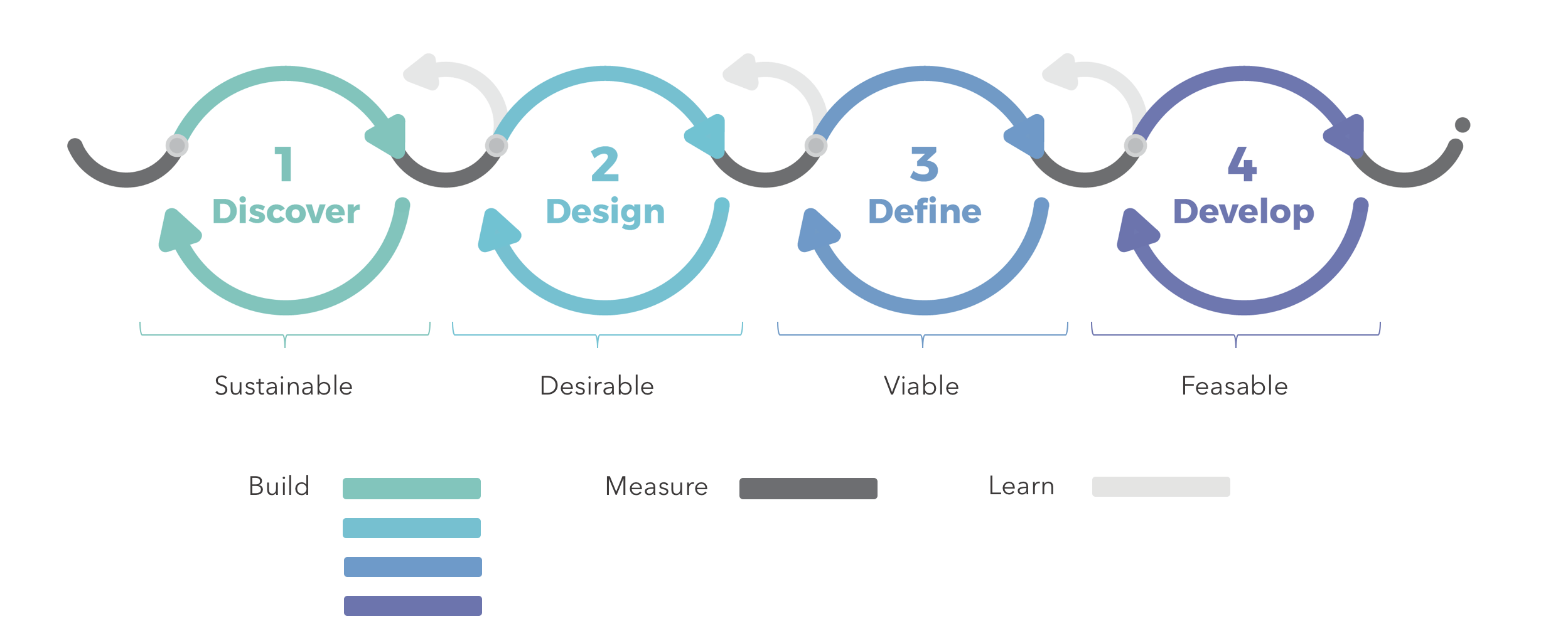
Cette méthodologie est idéale pour ne pas oublier de se poser les bonnes questions, comprendre que l’on innove dans un contexte particulier, pour résoudre un challenge précis pour des bénéficiaires, pour générer la créativité au sein des groupes mais aussi pour choisir la meilleure des solutions à approfondir et la rendre palpable.
Nous mettons l’accent sur la création d’une véritable atmosphère d’intelligence collective complémentaire aux outils d’innovation pour donner à chaque équipe les clés pour collaborer de manière efficace.
La co-création est au cœur du processus.
Nous avons de plus intégré toute une réflexion sur l’impact écologique et social de la solution. Notre méthodologie permet d’aller creuser du côté de la durabilité d’une solution.
Pour comprendre la méthodologie en détail, nous vous invitons à consulter les vidéos d’explication que nous avons réalisées.
Facili est la terminologie inclusive que nous empruntons à Collectiv-a pour en un mot désigner facilitatrice et facilitateur.
D’ailleurs si on parle de son rôle, pour nous lae facili :
- Assure et incarne une neutralité tout au long de l’accompagnement.
- Accompagne la mise en posture de collaboration des participant.es (pour briser les schémas de pensées traditionnels).
- Propose un cadre de fonctionnement clair pour lequel les participant.es valident leur adhésion et ainsi gère les attentes.
- Ouvre un espace de sécurité dans lequel chaque participant.e se sent légitime et confiant de pouvoir pleinement participer.
- Assure que chacun et chacune peut prendre la parole, gère les temps de parole.
- Synthétise et aide le groupe à tirer des enseignements.
- Facilite l’émergence de consensus et/ou de priorités au sein des groupes.

Contact our team
Questions about this training? Wondering if it’s right for you? Do you have a specific request or need more details? One of our experts will answer all your questions during a 30-minute online meeting. Don’t hesitate to get in touch!
Email: oceane@impact-valley.com